Saturday, February 9, 2013

Phillip Pullman's Amber Spyglass and Dante's Commedia


Title: Boats and Rivers
Link: The book is in the Level B Stacks of Rush Rhee


Although The Amber Spyglass is explicitly anti-religion, Phillip Pullman draws a lot of material from the Commedia in his chapters of the underworld.  According to the acknowledgements, Pullman drew heavily from Paradise Lost, and Milton drew heavily on the Commedia.

The world of the dead has an area where people must wait until they are ready to cross the river.  This area resembles the shores of ante-Purgatory since these people cannot return to the living, nor can they advance to the dead in the same way that the souls on ante-Purgatory cannot advance to Heaven, nor can they return to life and correct their mistakes.  However, these people are living who stumbled in from life (it's not clearly explained how that happens).   

Like Charon, the boatman is impossibly ancient with an oar and refuses to ferry the living unless they leave behind their animal representations of life.  Here, Dante and Pullman separate because the protagonists temporarily lose their representations of life whereas Dante presumably conquers his cowardice before crossing Acheron.  As the boatman ferries across the river, he refers to popes and kings who refused to believe that they died.  This is a bit similar to the soul in Canto 27 who believed he would go to Heaven only to have a demon thwart his salvation.

Unlike the Inferno, Pullman’s underworld is a bleak wasteland.  The harpies in The Amber Spyglass parallel the Furies at the Tower of Dis and the harpies in the wood of suicides in that the antagonists harass the protagonists in both stories.  The antagonists in both stories fail to cow the protagonists, but they subdue other souls, much like how the poets resist until the Angel arrives, but the harpies shred Iacopo in the wood of suicides.  In both stories, the harpies and Furies block the entrance to the underworld proper, but the protagonists force their way into the underworld. 

The souls in Pullman’s story resemble the souls of Purgatory in that both marvel at life such as Dante’s shadow or the protagonists’ warm bodies in a cold world.  The stories the protagonists share with the dead are like the conversations Dante has with the souls in the afterlife.  The conversations tend to focus on what was important to the dead when they were alive, such as nature or fame.  

The harpies guide the living protagonists through the underworld to a place where the underworld meets the surface.  Pullman adapts Virgil to the harpies, giving the harpies the ability to see through deception and guide the protagonists through the underworld.  The last word of the underworld arc ends with stars, just like how each canticle ends with stars, suggesting a new hope or future for the protagonists and Dante.

This is one of my favorite books, and connecting what I read years ago with other literature makes me want to reread other books.  Although fewer people read Purgatorio and Paradiso of the Commedia, their influences still tug on generations of authors. Contrary to what naysayers of humanities insist, the Commedia’s enduring power shows that it is alive and relevant.

Sunday, February 3, 2013

Biblical Parallels in Canto I

Dante’s Divine Comedy is known for its commentary on and reflection of Medieval Theology.  Inferno, the first book of The Divine Comedy contains many such references.  In my readings of scripture I have noticed many passages that remind me of passages in Inferno, and vice versa.  One such passage is Ephesians 4:17-19: “Having lost all sensitivity, they [the Gentiles] have given themselves over to sensuality so as to indulge in every kind of impurity, with a continual lust for more.”  This reminds me of Dante’s description of the she-wolf in Canto I, lines 94-99.  He writes, “she has a nature so evil and cruel that her greedy desire is never satisfied, and after feeding she is hungrier than before.”  The she-wolf thus seems to be a personification of the appetite for sin.  The Bible is full of passages that describe the inability of sin to satisfy the soul, despite the pleasure it gives for a moment.  Verses such as Hebrews 11:25 describe the “pleasures” of sin as “fleeting”, and Jesus, in response to the Samaritan woman at the well in John 4, who had lived life in adultery, said “Everyone who drinks this water [the water in the well] will be thirsty again,  but whoever drinks the water I give him will never thirst.”  Drinking the water from the well in this passage symbolizes satisfying one’s physical cravings.  Physical cravings can only be quenched in the short term (“Everyone who drinks this water will be thirsty again.”)  One who lives by “living water” on the other hand, which Christ gives and represents the Holy Spirit “will never thirst”.  The living water satisfies the soul, whereas the “physical water” quenches the fleshly desire for a time, only for it to return again.  The juxtaposition in this passage between physical water and living water is often said to represent the difference between indulging in sin – seeking to fill the soul with sinful pleasure – versus receiving the Holy Spirit, the living water of Christ, which satisfies the soul and quenches  thirst.
With the above scriptures in mind the passage in Inferno comes to life.  After “feeding” the she-wolf is “hungrier than before” and her greedy desire is never satisfied.  One further Biblical parallel for this passage is 2 Peter 2:9-14.  “The unrighteous”, Peter writes, “…and especially those who indulge in the lust of defiling passion and despise authority… like irrational animals, creatures of instinct, born to be caught and destroyed… will also be destroyed in their destruction, suffering wrong as the wage for their wrongdoing.  They count it pleasure to revel in the daytime…They have eyes full of adultery, insatiable for sin.  They entice unsteady souls.  They have hearts trained in greed…”  The she-wolf is portrayed in Canto I as an “irrational animal”, a “creature of instinct”, with “greedy [i.e., insatiable] desires”, and will later be destroyed by the greyhound (lines 97-99).
          The parallels continue into lines 100 – 106 as Dante introduces the greyhound, who “shall come” and put an end to the she-wolf (“make her die in pain”).  The greyhound “will feed on neither earth nor pelf, but on wisdom, love, and power…”  In light of the passage from John 4, the greyhound is one that does not live by well-water (it feeds “on neither earth nor pelf”), but rather by “living water” which Dante alludes to with “wisdom, love, and power.”  These three represent the Trinity, which is similar to Jesus’ own meaning of “living water”, which John identifies in John 7:38-39 as the Holy Spirit.  Just as the well-water is a symbol for the things or acts one might consume or engage in to satisfy a craving, so Dante’s “earth” and “pelf” relates to the things or ways in which the she-wolf seeks to satisfy her greed.  The statement that the greyhound will feed "neither on earth nor pelf" seems to come from nowhere, and thus it appears to have a symbolical meaning and imply that the she-wolf does feeds on them.  The "earth nor pelf" juxtaposition with “wisdom, love, and power” (which the greyhound feeds on) is therefore reminiscent of Jesus’ juxtaposition of drinking water in the well with drinking “living water”.  Taking this parallel into account imbues the text with a spiritual meaning and seems to fit the narrative of lines 91-111 very well.  Perhaps Dante even had in mind Jesus’ meeting with the Samaritan woman when he composed this passage.
 
Ephesians 4:17-19
Hebrews 11:25

John 4
2 Peter 2

Friday, February 1, 2013

Dante in Milton


Title: Comus, a masque at Ludlow Castle (Masques were extravagant theater productions)

Link: Level B at Rush Rhees Stacks


The story begins with the Attendant Spirit narrating his purpose, the setting, and the main villain.  The newly crowned king’s children return to their father after time away in study, but they have to travel through a forbidding forest.  By Jove’s command, the Attendant Spirit guides travelers of the forest to safety because Comus, the main antagonist, is the son of Circe and Bacchus, the former known to waylay sailors and the latter known to drink excessively, and he is just as powerful and devious as his mother.  The children search for water separately, and Comus tricks the sister into following him.

Like Canto 1, the dreary forest contains dangers that confuse and harm travelers, and the children fear what may come.  The Lady, who mirrors Dante, speaks of the danger that may befall her, and the terror she feels in the starless night.  

Comus, who lures travelers with wine, bewitches drinkers into beast/man chimeras that cause the drinkers to forget their identity.  Like the cowards in the Inferno, the transformation signifies corruption of their God-given appearance, and the transformed only live for themselves.  Milton, in a nod to Dante, uses the wolf and a lynx, which resembles a leopard, as the beasts that drinkers become.  The she-wolf and leopard in Dante represent greed and fraud respectively, which are the two traits that Comus represents as the son of Bacchus and Circe. 

Like Virgil, the Attendant Spirit rushes to the aid of the lost because a higher power commanded him.  He resides in the afterlife, but unlike Virgil and more like Beatrice and other blessed spirits in Paradiso, the Attendant Spirit resides in the spheres of the sky.  

Milton’s mastery of his predecessors is arguably as great as some scholars who study Dante, Homer, or Vergil today because Milton synthesizes and repurposes elements as a vehicle for his own ideas.  I find that exhilarating because, like Dante, Milton’s writing has vertigo-inducing depth that takes years, if not decades, to unravel.  As a history enthusiast and reader, tracing the line of succession fascinates me because each successor pays homage to his or her predecessors. 

Thursday, January 31, 2013

Dante's Inferno, The Comic Book

Link: You can see DC comic's website where they sell the comic books here. 
Entry: I like comic books, so I thought I would look up if Dante's Inferno had been done as a graphic novel. However, what I ended up finding was an adaptation  by DC comics, that is much different than the original tale. Based off of a video game by EA, the six issue mini-series begins as a much more heroic tale. Dante is this kind of warrior/super-hero being that must travel into hell to save Beatrice, who was murdered while he was fighting in the crusades.

Above, the cover art for "Dante's Inferno Issue #1".

Obviously, the story of our pilgrim has been changed from a story of self/world redemption by a spiritual journey, into an action-packed Heroic epic about someone who is fighting against Hell itself. While this is widely different from the original, it is also a very clever adaptation that applies to modern readers as well as lovers of the graphic novel/comic book. Action, bravery, battle - all these things excite and entice modern readers, more so than questions of spirituality and righteousness (for better or worse). In addition, the story between Beatrice and Dante is intensified, as the Devil tries to make Beatrice his wife! Rather than fighting for himself, physically or spiritually, Dante is fighting for love, instead of his love fighting/looking out for him.

Despite all the differences, the story does keep many elements of the narrative in tack. Even though Dante is descending into hell for a different purpose, he is doing so with the same fears about his purity/ability to do this and how this journey will change him if he does survive.

In the third book of the series, Dante's original circles of hell still keep their integrity. The second circle, of lust, is where the Devil wants to marry Beatrice (Cleopatra acting as maid of honor), so Dante must fight through Cerberus in the third circle of gluttony in order to rescue his wife!

But he is too late, and Beatrice becomes "Queen of Fire". The cover art to issue 4 is to the right. Dante must choose to either kill his love, or be killed by his love . . . Is Dante going to be the Hero of the story, and rescue his love, or will he become but a shadow of the warrior he once was after his journey through Hell? Read DC comics' to find out!


Tuesday, January 29, 2013

Demosthenes' hidden message

Title: The unknown tenth circle of Dante's Inferno. 
Link: Tenth Circle by Jodi Picoult-this novel is available in the stacks.
Entry: I love reading Jodi Picoult novels, although this is not one of my favorites. It was through this novel that I found out about Dante's Inferno and that propelled me to read the Inferno in high school. I chose to write about this novel because I wanted to show how much of the Inferno Picoult incorporated and how well and interesting she made it. A brief synopsis about the novel: it centers around a family(daughter, wife and husband) that are going through a rough patch. The husband, Daniel,  is a comics artist and his wife, Laura, is a professor at the local university. There is an obvious strain in their marriage that is made worsen by the wife's affair with one of her students. The plot centers around the murder investigation of the daughter's, Trixie, boyfriend, Jason. Throughout the novel, Daniel is writing   The Tenth Circle, a comic book that parallels his life. The comic book is also included in the novel and is spread out in particular places(mainly at the end of each chapter).
Picoult describes (through the character of Laura) Hell as a place where people are motionless and trapped in the ice which is to be juxtaposed to Heaven, a place full of motion and energy. That was their punishment for those at the very bottom of Hell. However, from what I have read in the Inferno, motion is still given for the Hell prisoners. This can be seen in Canto III as those that reside in Limbo are psychologically tormented and they sighing and moan-two actions that require motion. Also, in the entrance of Hell, the cowards are chasing down a unmarked flag as well as weeping and screaming-again three actions that require motion. Maybe Picoult interpretation comes from the fact that no motion at all is painful and it could be seen as a punishment. Or maybe it is an allusion to the ninth level of Hell...
The main character from the Inferno still play a big part in the novel. Daniel, who takes the place of Dante, is led by a more modern day Virgil through the levels of Hell. The comic book cover is an direct  allusion to the Inferno because it is a drawing of the gates of Hell and on the gates read: "Abandon All Hope ye Who Enter Here." The one major difference is that, unlike Dante, Daniel is on this journey to find his Trixie who was taken by Satan as well as a psychological/philosophical inner journey on finding out his identity.
The entrance of Hell, which is depicted in Canto II as the place for the cowards who were denied access into Heave and Hell, is filled with dead bodies of these cowards. One interesting spin Picoult puts in the novel is that the beasts which Dante meets in Canto I-II are the same beasts Daniel meets, but these beasts hold the "souls of the non-believers doomed to spend eternity as formless, nihilistic shadows"(pg. 59). Nihilistic is an intriguing word to describe those in the entrance of hell. For a person to be deemed a nihilist or nihilistic is that they denied all existence. Sound familiar? The unidentified people in the entrance of hell are seen as non-existent- they are not there, they don't exist. This is an amazing parallel with the Inferno and the novel that makes the novel even more interesting.
This novel has many intrinsic links to the Inferno that make it an interesting and enticing read, but I recommend reading it after finishing the Inferno. For that reason, I do not plan on saying more about this novel to avoid spoilers and give others the opportunity to find the links themselves. However, I do plan on expanding this blog entry once I finish the Inferno. 
After doing this blog and seeing the intrinsic links, I can now say that the Tenth Circle  is my favorite Jodi Picoult novel so far.
*For those who decide to read the novel, I have left a little message within the title that I hope you will understand. You must read the novel to understand what my title is talking about.

Saturday, December 1, 2012

When we as a class were first told we would have to blog about Dante once every fortnight, the assurance was "It won't be hard to think of material at all!  Dante comes up all the time in everyday life!"  Well, something like that anyway.  At the time I was dubious, and to be honest every other Friday, (or sometimes Saturday) I find myself searching my brain, the web and my friends for random Dante references that we havn't discussed in class or recitation.  This week I found myself doing this once again, for a full 24 hours this time (hence why this is a day late).  I stumbled upon one thing or another but either it was a tenuous connection at best or it simply wasn't something I wanted to write about.  

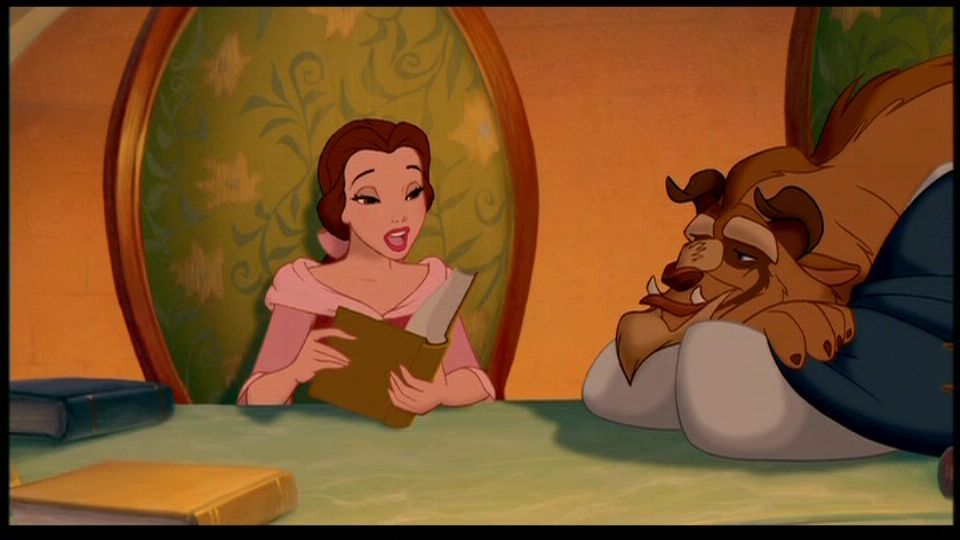
Anyway, this morning I found myself watching Beauty and the Beast as I ate my coco puffs and  searched the web for a topic, and suddenly an I found myself with an idea.  Finally something had come to me, with the suddenness of a light turning on, the way I remember being assured would happen.  I had already eliminated the idea of proposing that sugarless cereal be the punishment for the gluttons... (obviously a good idea, but seemed like it would be a short post.) Although now that I'm looking at the sun over the "O" I'm realizing that maybe those cornflakes really are God's will.

But back to the idea I got.  My roommate and I were watching the most amazing scene in all of movie history. If you didn't automatically think of the beautiful library, shame on you.  And we were talking about the changes the new addition have to it.  Primarily that the book they bond over, was changed from Camelot, to Romeo and Juliet.  

I had a eureka moment.  Back story: My friends and I have a habit of pointing out references to other movies, books, fairy tales or musicals when we watch movies.  Back to the narrative: I was explaining to my roommate how that scene was a possible reference to Dante, how Francesca and her lover were induced into love and the second circle due to Galeotto.  AKA Camelot.

Eureka!  The original book in Beauty and the Beast (that Belle teaches the Beast how to read) was Camelot.  Disney is so much more interesting than I ever imagined.  I want to have been the animator who thought to slip Camelot into the movie as a Galeotto.  And I really don't want to be the animator who when rewriting the movie was too stupid to catch the reference.  Well maybe stupid is too harsh, after all, those of us who do get the reference are really just incredibly intelligent and with it.  It's a special club that you dear reader are now a part of. (If you weren't before.) So we'll go with ignorant. 

   Thank you Disney.  I like when you utilize intelligent people for the creation of Children's movies.  If I ever decide to contribute to the population of the Earth, I will trust them to some of your movies.  

Inferno - Animated


Above is the link to a trailer to an animated film of Dante’s Inferno, titled ‘Dante’s Hell Animated’.  The trailer is a collection of scenes from a full-length animated film.  The defining feature of this film is that all of the dialogue and voice acting takes on the original Italian texts and utilizes English subtitles.  Apparently, this is one of the only major representations of the Comedy that uses the original text.  Though this is only a trailer for a longer production, it does hit most of the major scenes in Inferno.

One depiction that was interesting to see was the creature of fraud, Geryon.  In this film, he is an entirely green, serpent-esque being, with the face of a man, as he is described in Inferno.  In my imagination, I visualized Geryon as much less animal-like, and more like a human with animal characteristics, but this depiction make him look much more like a sphinx than how I visualized him.  Regardless, this is an interesting point to visualize, because as the ‘face of Fraud,’ Geryon represents the concept of external vs. internal qualities.  The premise of fraud as a sin is that one masks their true intentions with a facade.  In this way, it is crucial to depict Geryon as representative of this concept; he serves a very important purpose.

Another interesting depiction is Lucifer; he is shown with three heads, one red, one black, and one whitish-yellow.  These three heads are gnawing on the souls of Judas, Brutus, and Cassius, their blood dribbling down the chins, and each head is crying.  This is, in one sense, a piece of the climax of the Inferno, and this depiction is incredibly true to that described by Dante, with the exception of the long hair that Lucifer has (this may be a quality that Dante pointed out, but I can’t see it overtly).  Further, this animation does capture the terror of the image, without being overly ‘scary’, in a sense.  What I found most interesting about this segment in Inferno was the sense of awe and shock in Dante’s speech, but not like he is in the face of danger, but more so overwhelmed to observe what he is beholding.  This depiction captures the spectacular image before him.

All in all, this trailer seems to present the film as an animation that attempts to be as ‘true’ to Dante’s original words as they can.  Contrary to the film by Sandow Birk, the characters and dialogue inserted in the movie are those directly written by Dante.  It is an interesting trailer to watch, having seen the entirety of Birk’s film.  Birk takes a lot of liberties to not only translate the text and dialogue into English, but also to ‘translate the sentiment’ expressed by Dante and introduce characters who are analogous to those written in by Dante.  It is interesting to see this film, which does the opposite and brings to animated life the work of Dante.