Monday, November 19, 2012

The Saw movies and Dante?

So, I've only actually seen Saw II, and the beginning of Saw III, but I was  thinking about it, and they seem kind of reminiscent of Dante's Inferno. At least, Saw II seems that way. The whole concept that these people didn't appreciate their lives and do good with them reminded me of the Inferno, where the souls who in life had not lived without sin had to be punished.

So here's the basic synopsis of Saw II:   Link
A message was left at one of Jigsaw's crime scenes, for detective Mathews. Mathews and a SWAT team find the Jigsaw Killer, John, in a factory of some kind, where monitors show eight new people stuck in one of John's games, in an abandoned house. Among these eight people are Mathews' son, Daniel, and Amanda, the only known survivor of John's games. John assures Mathews that if he just stays and talks to John for long enough, he will find his son safe. This proves impossible for Mathews to do, however, even though he initially tried to do as John asked. He attacks John and starts beating him, desperate to get his son back. In the house, the victims have a hard time working together and listening to the rules. In the house, a gas is slowly poisoning them, but there are antidotes throughout the house that they have to find/complete tasks in order to get.

A lot of the tasks the victims must go through remind me of contrapassos. They're not exact, but these people are being punished for something they did/didn't do in real life. The morbidity of it and the various things they must do remind me of Inferno. There are tasks that are designed for each of them to do where they have to face a fear or live up to something shameful in their past. For example, Amanda is forced to search for an antidote in t pit of needles, and she used to be a drug addict. Here's a video:


The whole feel of the Saw universe to me, feels like the Infero. Like people need to face up to/be punished for things the had done. But it's also like a very messed up Purgatory, where they can repent for the things they had done by completing the tasks and facing up to their "demons" which (I believe, but I'm not sure) is what Purgatory is about.

Saturday, November 17, 2012

An eerie tree

During the past fortnight I spent a few days in the Adirondack Park.  Part of this trip was spent in front of a wonderful fireplace, while the majority of the trip was spent outside in the woods with the trees.  I'm sure the question running through your head right now is something along the lines of  "Am I looking at the right blog right now?  I thought I'd be reading about Dante! Who is this silly person?"

Rest assured this is the right blog and this is related to Dante.  Specifically to Dante's Inferno, canto XIII, aka the second ring of the 7th circle, aka the forest of the suicides. 

As I was hiking one day we heard a very eerie moan.  We looked around for some kind of loon, or other exotic northern mountain bird, but we didn't see anything.  So then we looked around for some kind of dying  animal.  We didn't really think it was a dying animal, but we didn't see any living animals... so yeah, we looked.  Long story short, a couple of minutes later, lots of pointless looking, and some fervent declarations that it was a. spooky and b.  probably just the wind,  we discovered what it in fact was.  It was a tree.

Naturally having read Dante, I tried to break off a limb... but I was too short to even reach them, let alone break one (I wouldn't make a very good epic heroine, especially since traversing in any world is best not done in heels, and a certain modicum of height is necessary to impose ones force.)   So, since I couldn't break off a limb to gain the trees attention, I knocked on it a few times in the hope that it would talk to me.  But alas, the tree had no warring city state or tale of corruption to relate to me.  It was sad.

I'm sure you've probably figured out by now that the tree was howling due to the previously mentioned wind that was blowing.  It was also almost hollow in its deadness.  So here I am, staring at a howling tree, knowing that I was going to have to have a blog post in a short few days, and the light bulb went off.  (Which was good because it was also just after sunset, and becoming quite dark.)  Anyway, the lighting was just such that the tree would have been photograph-able but still dark, which would have been ideal.  I was really excited, and pulled out my phone to take the picture, only to remember that my phone was dead, and the members of my family that were hiking with me don't like technology and didn't have either a phone or a camera that I could commandeer.

You ask: "What are the pictures of then? "   Excellent question.  The first is a picture of similar trees at the same place, earlier in the day, before my phone betrayed me in death.  The second is a close up of one of those trees, with branches that almost resemble hair, something that seems to be an appropriate analogy to the canto.  The third, is a picture of a forest path in Tuscany, near La Verna.  A sanctuary founded by St Francis.  This is intended to show what kind of trees Dante may have been thinking about while writing.  And finally, the fourth is a very unfocused picture of that same forest in Tuscany, at night.  This is intended to tie the other pictures to the actual canto, and thus complete the chain of trees.  

Friday, November 16, 2012

The Many Faces of Satan


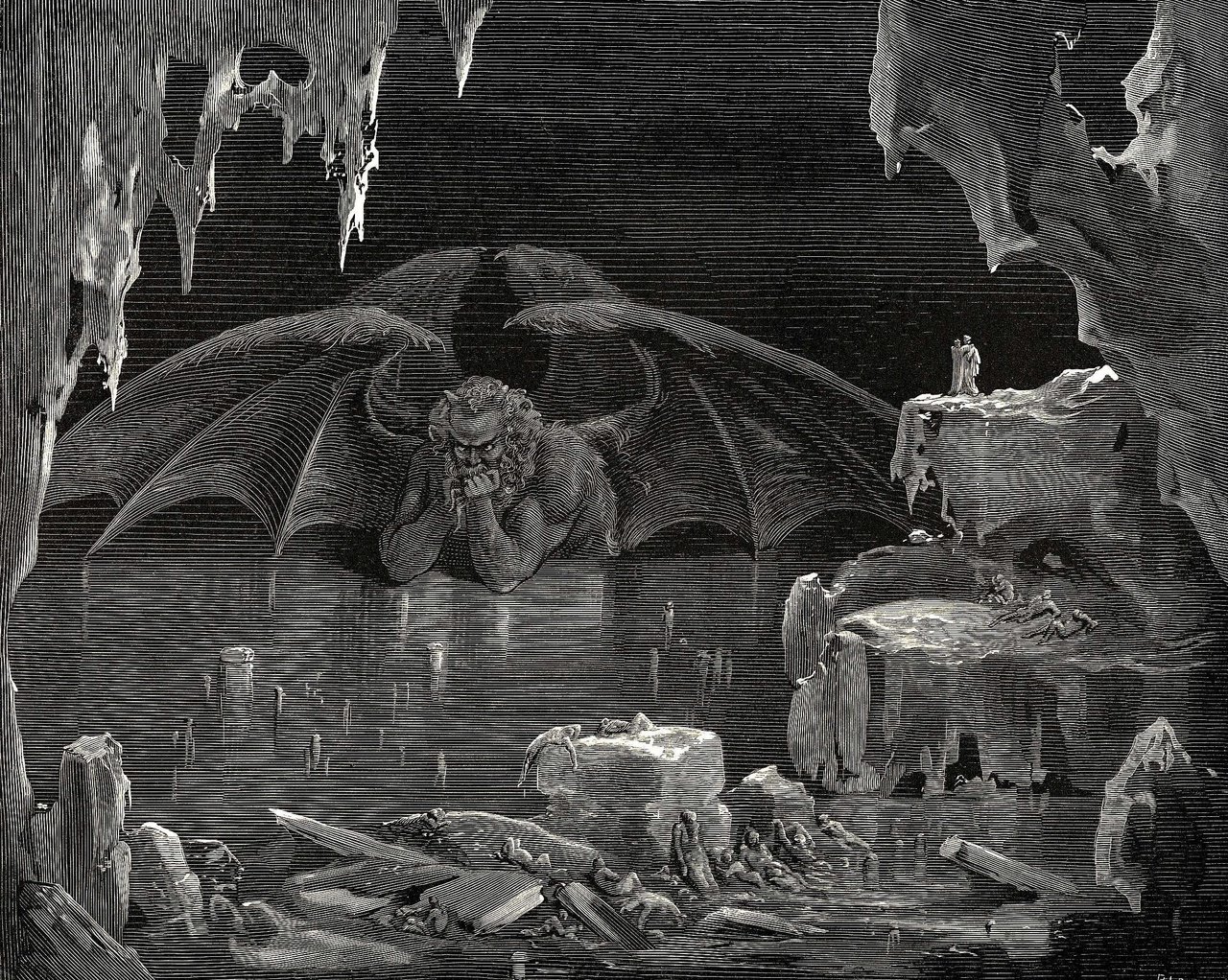
Although most of us have not had the opportunity and hopefully will never have the opportunity of directly seeing Satan in person, there are certain familiar images that immediately come to mind when his name is mentioned. The actual particulars of the image that come to mind will invariably be different from person to person; however, there will more or less exist a common thread that links these mosaic images into a unified tapestry of representation. The fact that there exists such a common thread is not surprising since much of what we think and believe is a product of our common cultural upbringing. The existence of this common thread is fundamentally rooted in what we as a society define evil to be. In general, for obvious reasons, evil is commonly despised and as such associated with the sensations of disgust and fear in all their possible permutations. Thus Satan, who is the ultimate personification of evil, is naturally visualized as repulsive by most people and Dante as well. It is this image of repulsiveness that I had in mind when I began searching for artistic renditions Satan. In my search, I found two artworks that gave two contrasting representations of Satan. The first of the artworks is Gustave Dores’ depiction of Dante’s version of Satan and the second is William Blake’s depiction of John Milton’s version of Satan from his poem Paradise Lost.
 As stated before, I expected there to be differing representations of Satan and so I was not too surprised by the difference itself between the Dore/Dante and the Blake/Milton artworks. However, I was surprised by the magnitude of difference that did exist between the two artworks. In fact, the two artworks differ so much in their representation of Satan that it is almost as if they are depicting two completely separate entities. If one deconstructs the artworks, it becomes evident at how each artwork’s individual components work together to create the difference. For instance, in terms of color choice, the Blake/Milton artwork makes use of bright and vibrant colors while the Dore/Dante artwork uses dark and dull colors. This difference in color choice has the effect of making the Satan in Blake/Milton appear more attractive and lively, and has the opposite effect of making the Satan in Dore/Dante appear more unpleasant and depressive. Additionally, the gapping difference between the two Satan is even further enlarged by their contrasting physical appearance. In the Dore/Dante artwork, Satan is physically repulsive with his beastial form and bat-like wings, while in the Blake/Milton artwork he is physically attractive with his fair appearance and looks like a man.
Moreover, due the great difference between the Dore/Dante and Blake/Milton representations of Satan, it seems that the idea of the unified tapestry of representation described earlier should certainly become undone at the seams. However, it does not become undone since the discrepancy in the representations does not result from any fundamental difference. Although I have not properly read Milton’s Paradise Lost, I think it is reasonable to assume that he was in no way seeking to advocate the goodness of evil. Rather, I think what he was attempting to do, as presented by Blake, was to emphasize the complexity of the personified Satan as a literary character.
Overall, I think the difference between the two representations help highlight two possible responses to the concept of Satan.  The most common type of response is the emotive response that relies on the immediate sensations of disgust and fear that we instinctively associate with the evil of Satan. The Dore/Dante artwork is closer to this type of response. Another type of response is the intellective response that is more developed and capable of dealing with the consequences of evil personified despite the apparent contradictions.
 

Dante in Anime

There was already a post about this topic, but the show is a favorite of mine so I decided to also blog about it. Full Metal Alchemist is an anime series that first broadcast in America in 2003. One of the major influences of the Divine Comedy in the show is the use of sins for symbolism in the show. The followers of the main antagonist are each soul-less humans who use code names of the deadly sins to distance themselves from their humanity. There creatures are Lust, Gluttony, Envy, Wrath, Greed, Sloth, and Pride. I thought the order of their appearance in the show as important due to the similarity to the order of the circles of Hell in Dante's Inferno. Even more obvious of a connection is the fact that the main antagonist, and leader of the "sins" is named Dante. Dante the pilgram is on the journey through the afterlife fr the sole purpose of find his way back to the righteous path. However the creators of this series seems be immensely corrupt. Dante the woman in fact commits each of the Seven Deadly Sins in her appearances:
"Pride: she has an air of superiority and speaks condescendingly whenever she is surrounded by the Homunculi and sees all those around her as inferior to herself. She feels the thousands of lives lost to the Philosopher's Stone are inconsequential because she was "worth it."
Envy: she showed hints of jealousy when Hohenheim refused her advances saying that Trisha was the only person he loved. Being the first Homunculus and sin created, it's possible that envy was the basis of which other events transpired.
Wrath: she was was quick to punish anyone who failed her or dared interefere—even former lover Hohenheim and her homuculi servants.
Sloth: despite being a very powerful Alchemist, she prefers to use other alchemists to forge the Stone for her and tasks the Homunculi with all the footwork. Also, like the Homunculus it was named after, she maintained a cold demeanour and was aloof to the world and its inhabitants (ironically, she claims to have committed her deeds to help humans from destroying themselves with the stone).
Greed: her plans to gain the Philosopher Stone are out of a selfish act of having her life extended.
Lust: the act of having her soul transferred to other bodies violates her victims. She also takes care in selecting more lascivious bodies to steal (perhaps suggestive of her vanity). Later, while meeting Hohenheim, she licks her own arm, states she hasn't tested out her new body (Lyra's body), suggesting they sleep together. She also makes mention of her plan to take over Rose's body and use it to seduce Edward and "be loved by the son of Hohenheim."
Her desire to have her life extended represents the sin of Gluttony: the sin of having more to the point of waste.
The series has implied that the transgression of Gluttony is Dante's most grievous offense. When she tells Edward that she is no longer human, the Homunculus Gluttony bursts into the room to carry out a scene that reveals him to be more human than she. When she later takes away Gluttony's mind (his last measure of humanity), she serves to transform him into the physical manifestation of her own monstrosity and is ultimately consumed by him. "(http://fma.wikia.com/wiki/Dante)
It is this distortion of such a religious and moral story that interested me in the connection between the two. The background for the society they live in is based on alchemy becoming the prominent science in stead of physics and mechanics.  Alchemy which is condemned as worthy of hell is praised in this show as the most profitably and well regarded profession. For entertainment purposes I think that this show is an excellent example of what can be done with the work in our modern time. 
                                                           Dante the FMA character


Main Character: Edward Elric


Satan in Milton's Paradise Lost and Dante's Inferno

The character of Satan is portrayed quite differently in Milton's Paradise Lost than he is in Dante's Inferno. Where Dante serves to illustrate Satan as a "dumb" being, Milton gives him a personality that attracts the audience and forces them to sympathize, to a certain degree, with him. He also makes him out to be an intellectual who has a purpose and seemingly "just" objective.

Dante makes Satan out to be intellectually inferior by presenting him as being unable to speak because he is chewing on the sinners. This serves to dehumanize Satan and emphasizes the issues of the "levels" (intellectual, animalistic and vegetative) of the soul that we have discussed in class. Satan, in the scene in which Dante sees him chewing on Judas, Brutus and Cassius, appears to be incapable of thought. He is doing a seemingly menial task that provides no such sort of intellectual stimulation. There is an emphasis on chewing, which portrays him in a rather primitive and animalistic fashion; thus leading us to believe that his "soul" is on a lower level than that of Dante's and therefore he is a character that we do not deem worthy of our respect.

Where Dante portrays Satan as an animalistic being with a soul/being that is something less than that of intelligent, Milton sees him as a character worthy of both respect and credibility in regards to intellectual competency. Satan is a complicated hero in Paradise Lost. He is complicated because we recognize that he is clearly a villain and yet we are sympathetic to his cause. Milton's Satan portrays God as being an unfair tyrant, one who deserved to be rebelled against. Now, having been banished to Hell, Satan is wondering what his purpose is. He wonders if God had considered him unusable wouldn't he have just killed him. He feels that since God has granted him his life, that God does have a purpose for him and this bothers him to a certain extent because God sees him as a tool that he can use for his own purposes.

Satan, in Paradise Lost, is the leader of a revolutionary group in Hell that is attempting to overthrow/stop the unfair rule of the "tyrant" God. In this regard we begin to see him as more of a character with which we can sympathize. He is a figure attempting to overthrow a tyrannical ruler who appears to have taken advantage of those who he is ruling.

Send My Regards to Dante


The preceding links are two images of stamps depicting scenes from Dante’s Inferno, created in honor of the 700th anniversary of Dante Alighieri.  The stamps themselves are Italian, used for postage throughout Italy, and their marked value is measured in lire, the currency that directly preceded the euro in Italy.  The stamps not only show the length of Dante’s legacy, but also the immense important of his work to the Italian people.

The first stamp depicts the scene in Canto I, in which Dante encounters a leopard, a lion, and a she-wolf  This is an iconic scene in Inferno as it introduces Dante’s struggles and beliefs pertaining to evil in the world.  Further, this scene, as depicted on a stamp coming from the Vatican, is crucial for Dante to establish his moral stance right from the beginning of the epic.  Consequently, this seems an incredibly appropriate scene for the Vatican to produce, without causing immense controversy with a scene more graphic or debated.  The beasts are clearly depicted with a terrifying stance and Dante is fearful.  The picture, even though it’s small, houses an accurate sentiment of the actual events of the first canto.

The second stamp shows canto X and Farinata, the Florentine who Dante talks with.  He is shown in a stone sepulcher, with another figure, who is Cavalcante.  It is interesting in the way it is depicted because the scene seems a lot less dark than it is described by Dante.  Dante and Vergil are depicted in blue and pink, whereas the shades are depicted naked.  This is a very important scene for the country of Italy altogether, as it features a chronicle of the past and future of Florence at the time of Dante’s writing. It is clear why this was chosen as a stamp image due to this historical importance.

The stamps themselves are not terribly intricate, but at the time of their production, it would have been a fun way to send mail to your friends.  In most countries, stamps signify legal tender, so using Dante’s images represent this level of importance for Italy.

Auguste Rodin: The Gates of Hell


Auguste Rodin, a French artist and sculptor (1840-1917) presented the world with his Dante- inspired masterpiece, known as the “Gates of Hell” or “Rodin’s Gates.” Although, we should take Purgatorio and paradiso into account, the piece is solely based on Inferno, with few elements from Purgatorio and Paradiso. Rodin, being immensely inspired by The Divine Comedy, decided to interpret it and the notion of hell in his views. Rodin was also inspired by 19th century French authors, and with this specific piece of work, he was inspired by the romantic poems of Charles Baudelaire. In his poems, “Baudelaire had described man as haunted by passions, that both delight and torment him. Desire knows no limit,” he writes, and this theme of uncontrollable desires is clearly seen in Dante’s inferno, and which Rodin demonstrates in his work with such details. Rodin was also inspired by Ovid's Metamorphoses, in which the depiction of women is the same as men; they too are indulged by the desires of lust, greed and violence. The gates depict the three furies whom Dante meets in Canto IX, and who “have lost their gruesome appearance and serpent-like hair; they are shown as the lovely maidens who once tried to allure the cunning Odysseus with their seductive songs.”
           
           There are several differences in the Rodin’s depiction of hell and those of Dante’s. For example, whereas in Dante's Inferno, every class of sinners is imprisoned in his specific ring and circle, in the flames of Rodin's 'Gates,' these compartments have been molten down and fused. However, despite the fusion of circles, the sinners stay isolated in their own sin and the punishment.
           
          The gates are divided into two parts: Paolo and Francesca dominate one part, and Ugolino and his sons, the other. We see Francesca sitting on a chair and Paolo sitting next to her, with Francesca’s arms wrapped around Paolo’s neck. One sees this as lovers doomed to be forever locked in each other's embrace though never to slake their passion," a perfect visual contra-passo. On the other side of the gate, we see Ugolino and his sons with a different type of passion. Ugolino is surrounded by his sons and tears run down the sons’ faces and Ugolino is shown as standing still, without any emotions or feelings.
Thus, I believe that Rodin’s Gates are a beautiful depiction of Dante’s Inferno, with many elements of the gate reflecting directly upon the sin and punishments. The sinners’ feelings and their pain are perfectly demonstrated by Rodin and the nine circles of hell are beautifully sculpted with much detail. Thus, Auguste Rodin’s work is simply a beautiful reflection of Dante’s Inferno.