Saturday, December 1, 2012

When we as a class were first told we would have to blog about Dante once every fortnight, the assurance was "It won't be hard to think of material at all!  Dante comes up all the time in everyday life!"  Well, something like that anyway.  At the time I was dubious, and to be honest every other Friday, (or sometimes Saturday) I find myself searching my brain, the web and my friends for random Dante references that we havn't discussed in class or recitation.  This week I found myself doing this once again, for a full 24 hours this time (hence why this is a day late).  I stumbled upon one thing or another but either it was a tenuous connection at best or it simply wasn't something I wanted to write about.  

Anyway, this morning I found myself watching Beauty and the Beast as I ate my coco puffs and  searched the web for a topic, and suddenly an I found myself with an idea.  Finally something had come to me, with the suddenness of a light turning on, the way I remember being assured would happen.  I had already eliminated the idea of proposing that sugarless cereal be the punishment for the gluttons... (obviously a good idea, but seemed like it would be a short post.) Although now that I'm looking at the sun over the "O" I'm realizing that maybe those cornflakes really are God's will.

But back to the idea I got.  My roommate and I were watching the most amazing scene in all of movie history. If you didn't automatically think of the beautiful library, shame on you.  And we were talking about the changes the new addition have to it.  Primarily that the book they bond over, was changed from Camelot, to Romeo and Juliet.  
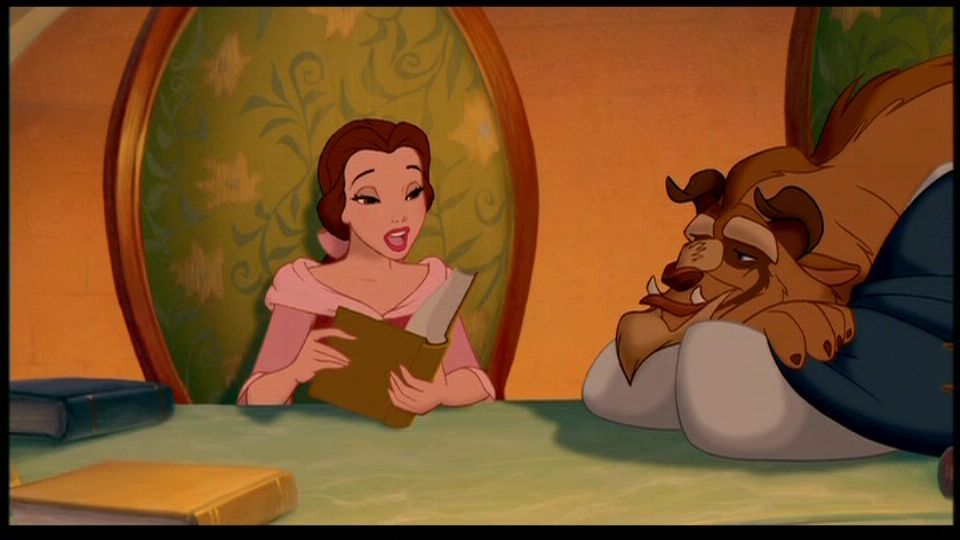
I had a eureka moment.  Back story: My friends and I have a habit of pointing out references to other movies, books, fairy tales or musicals when we watch movies.  Back to the narrative: I was explaining to my roommate how that scene was a possible reference to Dante, how Francesca and her lover were induced into love and the second circle due to Galeotto.  AKA Camelot.

Eureka!  The original book in Beauty and the Beast (that Belle teaches the Beast how to read) was Camelot.  Disney is so much more interesting than I ever imagined.  I want to have been the animator who thought to slip Camelot into the movie as a Galeotto.  And I really don't want to be the animator who when rewriting the movie was too stupid to catch the reference.  Well maybe stupid is too harsh, after all, those of us who do get the reference are really just incredibly intelligent and with it.  It's a special club that you dear reader are now a part of. (If you weren't before.) So we'll go with ignorant. 

   Thank you Disney.  I like when you utilize intelligent people for the creation of Children's movies.  If I ever decide to contribute to the population of the Earth, I will trust them to some of your movies.  

Inferno - Animated


Above is the link to a trailer to an animated film of Dante’s Inferno, titled ‘Dante’s Hell Animated’.  The trailer is a collection of scenes from a full-length animated film.  The defining feature of this film is that all of the dialogue and voice acting takes on the original Italian texts and utilizes English subtitles.  Apparently, this is one of the only major representations of the Comedy that uses the original text.  Though this is only a trailer for a longer production, it does hit most of the major scenes in Inferno.

One depiction that was interesting to see was the creature of fraud, Geryon.  In this film, he is an entirely green, serpent-esque being, with the face of a man, as he is described in Inferno.  In my imagination, I visualized Geryon as much less animal-like, and more like a human with animal characteristics, but this depiction make him look much more like a sphinx than how I visualized him.  Regardless, this is an interesting point to visualize, because as the ‘face of Fraud,’ Geryon represents the concept of external vs. internal qualities.  The premise of fraud as a sin is that one masks their true intentions with a facade.  In this way, it is crucial to depict Geryon as representative of this concept; he serves a very important purpose.

Another interesting depiction is Lucifer; he is shown with three heads, one red, one black, and one whitish-yellow.  These three heads are gnawing on the souls of Judas, Brutus, and Cassius, their blood dribbling down the chins, and each head is crying.  This is, in one sense, a piece of the climax of the Inferno, and this depiction is incredibly true to that described by Dante, with the exception of the long hair that Lucifer has (this may be a quality that Dante pointed out, but I can’t see it overtly).  Further, this animation does capture the terror of the image, without being overly ‘scary’, in a sense.  What I found most interesting about this segment in Inferno was the sense of awe and shock in Dante’s speech, but not like he is in the face of danger, but more so overwhelmed to observe what he is beholding.  This depiction captures the spectacular image before him.

All in all, this trailer seems to present the film as an animation that attempts to be as ‘true’ to Dante’s original words as they can.  Contrary to the film by Sandow Birk, the characters and dialogue inserted in the movie are those directly written by Dante.  It is an interesting trailer to watch, having seen the entirety of Birk’s film.  Birk takes a lot of liberties to not only translate the text and dialogue into English, but also to ‘translate the sentiment’ expressed by Dante and introduce characters who are analogous to those written in by Dante.  It is interesting to see this film, which does the opposite and brings to animated life the work of Dante.

Friday, November 30, 2012

Dante's Inferno film (1935)

This film was loosely based on Dante's original work. Harry Lachman directed this black and white picture in 1937, and actor Spencer Tracey stars in it. It is about a man named Jim Carter who has recently taken over a fairground show that illustrated scenes from Dante's Inferno. After bribing an inspector to pass the ride despite dangerous malfunctions,  a fatal accident occurs on the ride. Carter is haunted by a scene of hell. This 10 minute sequence is the highlight of the movie, and the most relevant to our course. It depicts the boatman, the marching souls of the ante chamber, as well a what appears to be a vague writhing pit of souls. The most moving scene for me personally was that of the souls in individual pits that were smoking. I can only assume these are the blasphemous, and they are the most clear figures of the 10 minute scene. Lachman's choice to have the tombs closing on the souls entrapped in them was an interesting choice. In the original work the lids were not to be closed until the Last Judgement occurred, but it made a powerful scene to see the souls trying to hold the lids of their tombs open. The suicides were also visually intense. The people were fused together to create huge trees, but you could still see the individual souls writhing in agony. The significant differences I think were the scenes of souls enchained to the ground, and the souls pushing/falling off of cliffs. Lachman is a also a post-impressionist artist, and this shines through in his film. If anything the Inferno scene is worth watching, but the entire movie was an interesting use of the work for a (semi) modern interpretation.


The entire film is on youtube at this link
Dante's Inferno film (1935)

The Scene of his interpretation of Inferno is at this link
10 minute Scene of Hell

Dante represented by Auguste Rodin as "The Thinker"


          Auguste Rodin, a French artist and sculptor (1840-1917) presented the world with his Dante- inspired masterpiece, known as the “Gates of Hell” or “Rodin’s Gates.” However, immediately after the presentation of the piece, the central figure, or as it is known, the Thinker, acquired much attention, even before it was finished. The figure’s body language further involves the reader into much thought about the representation of the Divine Comedy in the piece. With the figure seated on a rock, and appearing in deep, "pensive thought," one can easily make out the elements of Inferno through the body language. "The body, twisted in tension is overwhelmed with the conditions of Inferno. The toes are twisted as to perhaps a response to such aforementioned conditions. And whereas, one arm is supporting the pensive head, the other is as free as could be – perhaps to grasp the degree of the reality depicted by the vivid imagery of Inferno." The figure, it is said was meant to stand out from the rest of "The gates of Hell," because Rodin wanted to emphasize on the creator of such  an exceptional piece of work.

         Though it was originally exhibited in an exhibit in Copenhagen in 1888, "The Thinker was thought to represent Dante, as a person." Many comparisons were made between the two – "as Dante too, used to sit on a rock in Florence called Sasso di Dante." However, later on it was inferred that the piece held a deeper meaning. It was representing the themes of the Divine Comedy rather than representing "a personal connection to Dante." The figure's facial features, which include the arching of the brows, followed by the flared nostrils lead one to believe that the figure is indeed upset. After focusing on what indeed causes such upset, one needs to look no further than the text of Inferno itself.  The punishments of the souls, the harshness of the punishment, the cruel surroundings of inferno, can all be seen to have caused such facial expressions of the Thinker. Perhaps Rodin was trying to include the frustration that Dante felt, by establishing personal connections with the souls and certain themes of Inferno, for example, Dante's connection with Francesca and Paola and their story can easily be seen in Canto IV. Furthermore, Dante's frustrations with the souls of the Heretics' circle and and other political individuals in inferno may also reflect on the facial expressions of the Thinker. The deep meaning of the Thinker is what intrigues most people. Rodin’s ability to represent multiple themes, sentiments, imagery and symbolism in one piece is what is enthralling to most people. "The Thinker’s elevated position and broad shoulders give the viewer a powerful appearance," which only enhances the overall appearance of the piece.

         Consequently, Rodin’s “Gates of Hell” are a beautiful depiction of Dante’s Divine Comedy, with many elements of the gate reflecting directly upon the sin and punishments. The sinners’ feelings and their pain are perfectly demonstrated by Rodin and the nine circles of hell are beautifully sculpted with much detail. Furthermore, the depiction of Dante in the Thinker is simply stunning. The figure represents not only Dante as an individual, but also his works of the Divine Comedy, by further representing the themes of the Inferno, Purgatorio and the Paradiso, demonstrated by the the body language of the figure. 

iDante - the iphone/ipad app

iDante, by Carraro multimedia, is an app available for purchase on the iTunes store for the iPhone or the iPad; additionally it is available as a Touch eBook. It is designed to aid in enhancing the reading of the literary text by providing interactive images, 3 dimensional and multimedia content. Even the most avid Dante enthusiasts stand to gain a new experience from this application, as verses and imagery combine in a "new illuminated cartoon digital codex" which aids in making the individual episodes and the characters in The Divine Comedy easier to interpret and understand.

The primary seventy episodes of Dante's journey through Inferno, Purgatorio and Paradiso are thoroughly illustrated with 500 colorized images drawn by Gustave Dore which are accompanied by original tercets and versus. Additionally, iDante provides a 3D map/model of Inferno, Purgatory and Paradise which aid in the understanding of the geography of the circles, terraces and celestial spheres. Users are able to visit these locations and observe 360 degree panoramic reconstructions of such scenes, as can be observed in the following link which gives a brief demonstration of some of the applications of iDante. This is the introductory graphics video for the application: http://www.youtube.com/watch?v=FHA0y4KPFM8

The main contents (some of which have already been described) of the application, according to the iTunes store include: full text of Dante Alighieri's poem in English and the original Italian version, full indices for the 100 cantos, over 500 colorized images, the 70 main episodes of Dante's story illustrated b cartoon illuminations, a 3D model of Hell, Purgatory and Paradise, 360 degree panoramic reconstructions and an introductory graphics video (see above link).

Here we can see the app being used on an iPhone: http://www.youtube.com/watch?v=JJJCryJSc-E
It essentially acts as a book, with illustrations, on steroids, as now, the reader of the text is able to move around within the images of the story. They are able to interact with and explore the environment that Dante so vividly describes. The application, quite literally takes you into Dante's world. The application will notify the reader when an interactive feature, that illustrates or helps explain the current scene that the reader is reading about, such as a 3 dimensional image, or a map is available.

Dante and Existentialism


Many themes ideas from Dante’s Divine Comedies found their way into the existentialist movement of the late 19th and early 20th centuries. A large part of these common themes have to do with human freedom. Søren Kirkegaard, one of the first major forces in existentialism, hypothesized that we are all free and have the capacity to determine our own lives. Dante was an earlier proponent of this idea, most notably at the end of The Inferno, when he distinctly described the devil as being powerless and weak, thus putting the responsibility for human sin on the individual. The idea of an authentic existence was also very important to both Dante and the existentialists. Dante conveyed the need for authenticity when he depicted his former teacher, Brunetto Latini, who wrote his works to attain fame and recognition rather than seek truth or enlightenment. Existentialists believed the world was bleak, and personal choice was all we had to create a meaningful life. That is why existentialists taught that we should always question our choices and make sure we are being true to ourselves.
Kirkegaard
            In the 20th century, the existential themes that developed more closely paralleled Dante’s Purgatorio, where souls must struggle to find direction and meaning. Jean-Paul Sartre described this struggle as “Vertigo”, where one gets overwhelmed by all of the possibilities before him. Dante’s purgatory is a place where there is no clear path to salvation, only a constant, exhausting trek up the mountain. The souls in Purgatory must find enlightenment for themselves, and the choices they make there will affect whether they get into heaven.
            Despite having so much in common, existentialism and Dante break away completely when it comes to spirituality. Existentialists believed that there is no god, or if there is, he has no interest in the concerns of the human world. They also believed that life on earth had no inherent meaning, and humans are taxed with the burden of creating their own meaning for life. Dante, however, was a devout Catholic. He believed that humans were on earth to carry out God’s will and unlike the existentialists, who believed there are no moral absolutes, Dante most certainly believed there was a right way and a wrong way to do things.  These differences are striking, but it’s clear that Dante faced the same issues as the later Existential thinkers, coming to some of the same conclusions. Both came to realize the importance of human choices, and how they affect our spirit. Dante had his own existential crisis, but he experienced it through the scope of his Christian faith.

Thursday, November 29, 2012

Molding Dante into Reasoning

As we were talking in class, Dante's writing have been read and analyzed for such a long time that it has been influential in multiple concepts and theories. People throughout time have either referenced Dante or used his writings as a model to base their ideas on. References to Dante go from Milton and Chaucer to Marx and Mussolini to further his fascist regime. This is important especially in this day and age where most of us see fascism as an evil political system and might find it hard to believe an association between such a beloved text and a hated system exists.

Karl Marx uses Dante's words from Purgatorio to end his Das Kapital book in which he criticizes the political economy. The preface ends with Dante's words "follow your own road, and let the people talk." This kind of reference is extended as the fascist regime gained power and Mussolini was attempting to give Italy a nationalistic identity, something that Dante was seriously concerned about. As we read in canto 6 of Purgatorio, Dante goes on a rant against Italy and how separated each city had become. Dante hates that Italian cities cannot get along together or stay together as they use to during the Empire. While Sordello and Virgil embrace at the simple mention of their common city, Italians are constantly at each others' throats or blocked off by their walls or moats. Although a lack of a true leader concerns Dante as he blames Italy for having an empty saddle, it is hard to imagine that Dante would have ever thought that Mussolini and a fascist regime would be the appropriate government.

We won't know if fascism was the government that Dante was imagining but that did not stop Mussolini from using Dante's works to further his cause. In an attempt to show everything great about Italy and enhance their reputation abroad, Mussolini even had a building planned to be constructed named the Danteum. It was supposed to be built in Rome which Dante would obviously have approved of since he viewed Rome as the center of the Empire from which a strong government should control and lead the nation. The Danteum would have been quite an amazing structure as it would be built to recreate Dante's journey from the woods, to Hell, Purgatory, and Paradise. Although it was never built, this structure would have been quite a statement, especially because it was ordered by the fascist government. Dante desired a strong government and his constant speeches about the lack of a strong leader led to the fascist government to use him as a bedrock for this structure that was supposed to symbolize the strong government of the fascist regime.

While the fascist regime used Dante's work as a support for their unification of the state, other people used it to fight against such powerful regimes. Primo Levi, an Italian Jew who spent a year in Auschwitz, wrote a book about his experience called If This Is a Man, and in his book he names one of his chapters Canto of Ulysses. In this chapter he talks about how he struggled to remain a man in Auschwitz and he used Dante as his way or remaining a man. Even though he feared remembering Dante because it would bring back memories of home and life prior to Auschwitz, he realizes that it is a necessary sacrifice. This reminds us of how Ugolino and Francesca both talk about how painful it is to recall their stories because they have to think about the happy things they now miss in their situations. For Primo Levi, remembering Dante is his way to coping with, and survive the fires of the crematorium which he compares to the fires of Hell in Dante's Inferno.

As we see with these example, Dante's writings have so much information, and tackle so much in society, that it is easy to manipulate his writing to fit whatever agenda someone has, whether is be Marx for his book, Mussolini for his government, or Levi for his survival. Dante's Divine Comedy has been and will continue to be used and interpreted however people find the need to accomplish their goals.